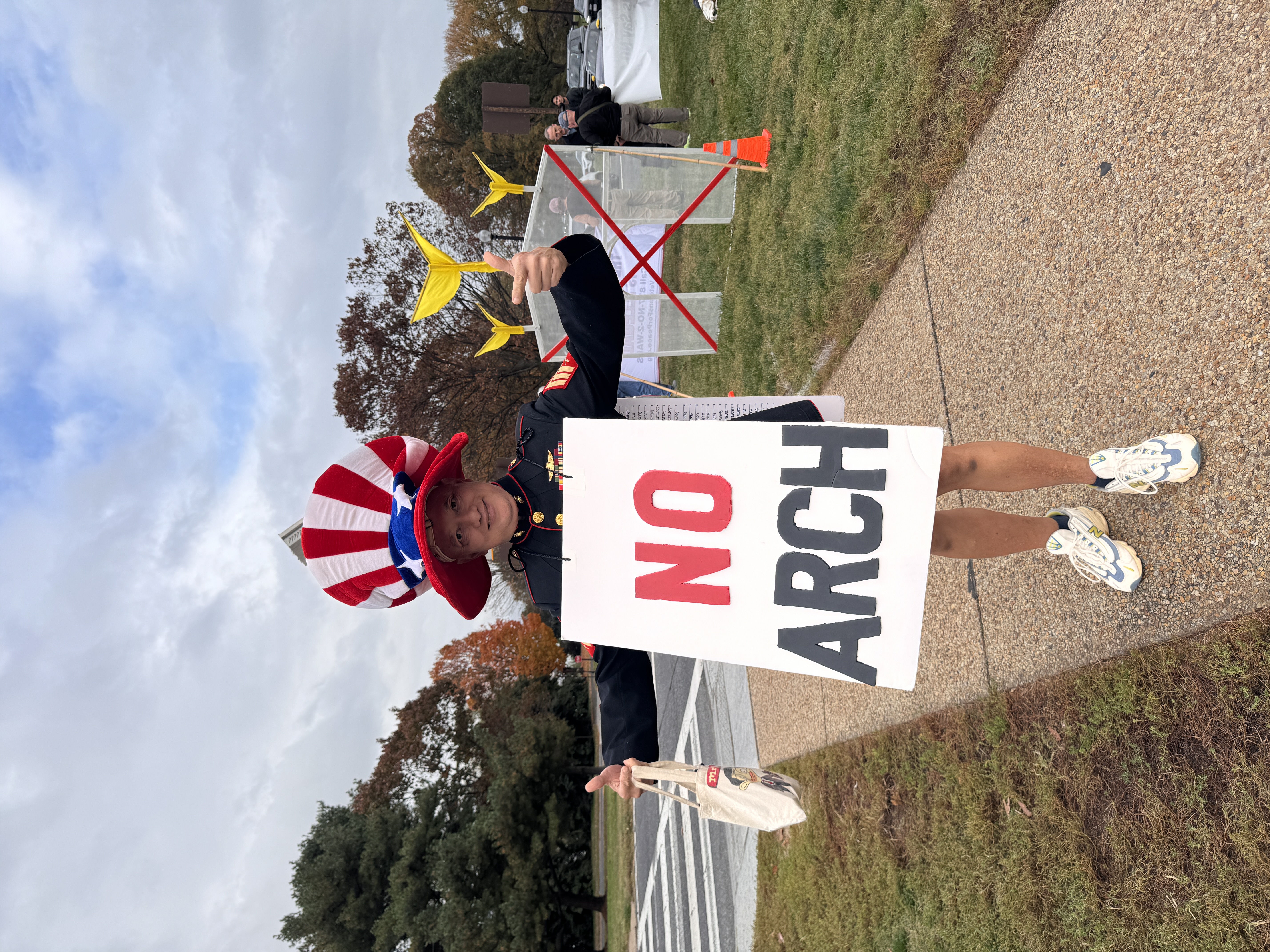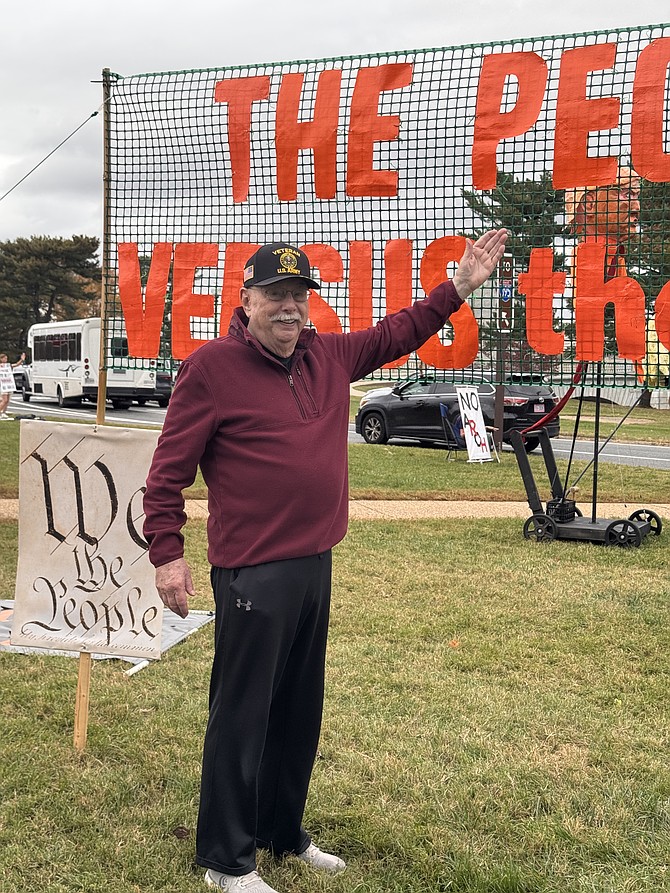
Rick Silverman was angry. He was also deeply moved. An upbeat, conversational man, he had just turned 83 and came over to Memorial Circle on November 5 to express his unhappiness with the proposed “Trump Arch.” He visits the cemetery often as his father is buried there. On one visit, he happened to see a man kneeling by a grave, crying. At a loss for what to do, he went over and consoled the man, asking him about the bottle of Jack Daniels and two glasses sitting by the grave. “This is the bottle I opened with my son when he went off to war,” said the man. “I told him when he came home, we would finish it.” Silverman looked down at the almost full bottle of liquor that would never be finished. “That is the thing,” he said. “This is a place where people come to feel close to their family members. It’s hallowed ground. It’s not a place for tourists to come gawk or for a president who dodged the draft to put up a monument on a whim.”
Protesters, primarily from “Third Act,” a group of activists who also helped vote in Democrats during the Mid-terms, knew a lot about the proposed construction. “It’s going to take three years or more to build,” they noted. “It will cause disruption in family visits to the gravesites. And how will grieving families feel when a nearby construction site includes a place for snipers and drones, instruments of violence in a place where “rest in peace” is enshrined?”
Several mentioned the arch would have elevators, a restaurant, and gift shop. “It’s not just an arch,” said one member of Third Act, “ I’ve been in the tourist business. This arch will bring busloads of people and congestion. The view down from Arlington House, expressly why the cemetery was built where it was and how it was built with that direct line to the Lincoln Memorial, will be obstructed. “ (The straight line was intended to visually unite North and South—linking Abraham Lincoln (the Union) with Robert E. Lee’s former home (the Confederacy) across the graves of fallen soldiers.)
Other speakers spoke about outrage at the lack of adherence to legal requirements such as height limits. “Over 100,000 comments have been submitted to the commission - mostly against,” said one speaker. “We saw clearly on Tuesday night the contempt the American people have for the kind of illegal activity this arch represents, and the American people will continue to prevail!”
The National Parks Commission got an earful, with speakers also noting the VVA (Vietnam Veterans of America), a group of 94,000 vets, was not given a voice in the decision and one particularly angry protester pointed out “it was clear the commission had already made up its mind and was “kowtowing” to the whims of a vain president” to bend the rules on construction of this arch.
U.S. Army Colonel (Ret.) Anne Wright was there in army fatigues, a dynamic personality who felt so strongly about the arch she flew here from her home in Hawaii to protest. A woman of principle and a superior officer in both the army and the foreign service, she sent a strongly worded letter to Colin Powell in 2003, resigning from the service because of the invasion of Iraq. She was one of three foreign service officers to resign. She served in all the tough places: Nicaragua, Afghanistan, Sierra Leone, Mongolia, to name a few.
Protesters (and the roughly 10 reporters camped around the area) planned to stay as long as it took for the Commission to vote, and for U.S. District Judge Tanya Chutkan to be informed, as she had asked to be within ten minutes of the decision. Once told, she issued a 14-day temporary restraining order halting construction on Trump’s proposed 250-foot triumphal arch. On November 10, nine members of the Kennedy family moved to join pending motions seeking a preliminary injunction to block the Trump administration from beginning construction of the arch.
“I just turned 83,” Rick Silverman said. “I don’t have a lot of time left to serve my country, but I know this is wrong and I will lay down in front of the bulldozers if they start digging tomorrow.”
.